ARISS contact planned with Gymnasium Siegburg, Germany
An ARISS
educational radio contact is planned with Gymnasium Siegburg, Germany.
The event is scheduled Monday September 1st, 2014 at 13.12.45 UTC, which
is 15.12.54 CEST. It will be a direct contact, operated by DN6KW.
Downlink signals will be audible in Europe on 145.800 MHz narrowband FM.
The Ham Video transmitter will possibly be tested during this contact.
School presentation:
Our
school is a whole-day (8 AM - 4 PM) high school and college (1,000
students, 100 staff) that prepares students for the final examination
after 8 years studies. The school, situated close to the centre of
Siegburg, sits in the middle of a park like campus.
We teach the
languages traditionally taught in Germany, and alongside offer our
students ABIBAC, a bi-lingual language curriculum, which opens the
possibility of getting the French Baccalaureate, in addition to the
German Abitur. These students acquire admission to not only German, but
also to French universities. Some subjects are also taught in English.
Both our world and our society and, thus, education, are subject to constant change.
Three
important pillars, however, are considered to be permanent and
accordingly, make Gymnasium Siegburg Alleestraße a reliable partner:
- Educational and academic qualities and commitment to ethical values
- Integration of all groups and elements that constitute school life
- Focus on health and wellbeing of students and staff
In
addition to our foreign language profile we encourage and support
musically interested students in special classes in which it is
obligatory for all members to play an instrument. Students may later opt
for music as their major subject.
A very wide range of natural sciences completes our school profile.
For
several years now our school has been in contact with the University of
Bonn working on a project in space science and remote sensing,
sponsored by DLR (German Aerospace Centre) and BMWi (Federal Ministry of
Economics and Technology). The project allows our junior and senior
students to participate in an analysis of data as well as in a satellite
surveying remote sensing with reference to scientific problems.
For
this reason, our school community is very pleased and proud to have been
selected for the live call in September with Dr. Alexander Gerst on the
ISS.
The space conversation will be conducted in German.
Students will ask as many of following questions as time allows:
1. Leonie (11): Wie fühlt sich Schwerelosigkeit an? Können Sie das erklären?
2. Leon (11): Wie war Ihr erster Weltraumspaziergang?
3. Jay (15): Wann, glauben Sie, kann man zum Mars reisen?
4. Sara-Marie (15): Was macht Ihnen am meisten Spaß an Ihrer Mission?
5. Matthias (15): Haben Sie, trotz Ihres Intensivtrainings, manchmal noch Bedenken, etwas falsch zu machen?
6. Quock: Was tun Sie in Ihrer Freizeit?
7. Max (16): Was haben Sie als persönlichen Gegenstand mitgenommen?
8. Saskia (18): Was vermissen Sie am meisten von der Erde?
9. Tobias (17): Was war das einflussreichste Forschungsergebnis, dass auf der ISS erzielt wurde?
10. Daniel (16): Gibt es schon medizinische oder physikalische Fortschritte?
11. Bilal (14): Haben Experimente bereits zu Ergebnissen geführt?
12. Merlin (15): Wie umständlich sind Reparaturen außerhalb der ISS?
13. Paul (14): Was ist das größte Risiko, was während des Fluges passieren kann?
14. This (14): Gab es bereits einmal einen Not- oder Krankheitsfall?
15. Caronlin (15): Wie viel Strom verbraucht die ISS?
16. Chantal (11): Kann es zu Stromausfällen auf der ISS kommen?
17. Tim (12): Wie weit ist die ISS automatisiert?
18. Sebastian (20): Wie viele Meter Kabel wurden in der ISS verbaut?
19. Jennifer (17): Wie schützt sich die Crew vor den kosmischen Strahlen?
20. Victoria (11): Wie ist das Housekeeping auf der ISS organisiert?
ARISS
is an international educational outreach program partnering the
participating space agencies, NASA, Russian Space Agency, ESA, CNES,
JAXA, and CSA, with the AMSAT and IARU organizations from participating
countries.
ARISS offers an opportunity for students to experience
the excitement of Amateur Radio by talking directly with crewmembers
onboard the International Space Station. Teachers, parents and
communities see, first hand, how Amateur Radio and crewmembers on ISS
can energize youngsters' interest in science, technology and learning.
73,
Gaston Bertels, ON4WF
ARISS Europe Chairman
Source : ARISS
f6agv (AT) free.fr

F6AGV : ACTUALITE du RADIO AMATEURISME
vendredi 29 août 2014
dimanche 24 août 2014
LANCEMENT SOYOUZ ANOMALIE D'INJECTION DES SATELLITES 5 et 6 de la CONSTELLATION GALILEO

Vue CNES
Informations au 23 août 2014 :
http://www.esa.int/fre/ESA_in_your_country/Belgium_-_Francais/Lancement_Soyouz_anomalie_d_injection_des_satellites_Galileo
Suite à l’annonce faite par Arianespace relative à l’anomalie d’injection des satellites Galileo, les équipes des industriels et des agences impliquées dans la mise à poste des satellites examinent les potentielles implications sur la mission.
Les signaux des deux satellites ont été acquis, et ceux-ci sont en sécurité, sous le contrôle de l’ESOC, le centre des opérations de l’ESA situé à Darmstadt, en Allemagne.
Des informations supplémentaires sur la condition des satellites seront communiquées après une analyse préliminaire de la situation.
Lancement Soyuz VS09 : anomalie d'injection des satellites Galileo
Résultats des premières analyses de données
Arianespace a lancé le 22 août 2014, à 9:27 heure locale en Guyane, un lanceur Soyouz ST transportant deux satellites de la constellation Galileo.
Le décollage et la première partie de la mission se sont déroulés de façon normale, conduisant à une séparation des satellites selon la séquence prévue, et à la réception du signal. Ce n’est qu’après la séparation des satellites, et en temps différé, que l’exploitation progressive des informations fournies par les stations de télémesure de l’ESA et du CNES a révélé que l’orbite atteinte n’était pas conforme à l’attendue. L’orbite visée était circulaire, inclinée à 55 degrés et avec un demi grand axe de 29 900 km. L’orbite atteinte est elliptique avec une excentricité de 0,23, un demi grand axe de 26 200 km et une inclinaison de 49,8 degrés.
L’état et le positionnement de l’étage supérieur Fregat et des deux satellites sont stables et ne présentent aucun risque pour les populations. L’étage Fregat a d’ailleurs été vidangé de ses ergols résiduels et dépressurisé de façon normale. Selon les premières analyses effectuées, une anomalie se serait produite pendant la phase de vol de l’étage supérieur Fregat, conduisant à une injection des satellites sur une orbite non-conforme.
Les études et les analyses de données se poursuivent à Kourou (Guyane) et à Evry sous la coordination de Stéphane Israël, PDG d’Arianespace. Elles sont menées en collaboration avec les partenaires russes du programme Soyuz en Guyane (Roscosmos et les industriels RKTs-Progress et NPO-Lavotchkine), ainsi qu’avec notre client (ESA) et ses partenaires industriels, afin de déterminer le périmètre de l’anomalie et son impact sur la mission.
« Notre objectif est de faire toute la lumière sur cette anomalie. Les équipes d’Arianespace sont mobilisées pour y parvenir. Arianespace mandatera dès lundi, en association avec l’ESA et la Commission européenne, une commission d’enquête indépendante pour définir les causes précises de cette anomalie et en tirer les conséquences et actions correctrices permettant un retour en vol en toute sécurité et dans les meilleurs délais du lanceur Soyouz depuis le CSG. Cette commission travaillera en coordination avec les partenaires russes du programme Soyouz en Guyane. Arianespace est déterminée a servir au plus vite les ambitions spatiales de l'Union européenne dans le cadre du programme Galileo. Nous remercions l'ESA, la Commission européenne et le CNES pour la qualité de nos échanges depuis que la survenance d'une anomalie a été connue. Même s'il est trop tôt pour en déterminer les causes précises, nous tenons à présenter nos excuses les plus sincères a l'ESA et a la Commission européenne pour cette injection sur une orbite non confome", a déclaré Stéphane Israël, PDG d’Arianespace.
-----------------------------------------------------
Galileo satellites experience orbital injection anomaly
on Soyuz launch Initial report
On August 22, 2014, at 9:27 am local time in French Guiana, a Soyuz ST rocket lifted off with the first two satellites in the Galileo constellation.
The liftoff and first part of the mission proceeded nominally, leading to release of the satellites according to the planned timetable, and reception of signals from the satellites. It was only a certain time after the separation of the satellites that the ongoing analysis of the data provided by the telemetry stations operated by the European Space Agency (ESA) and the French space agency CNES showed that the satellites were not in the expected orbit.
The targeted orbit was circular, inclined at 55 degrees with a semi major axis of 29,900 kilometers. The satellites are now in an elliptical orbit, with excentricity of 0.23, a semi major axis of 26,200 km and inclined at 49.8 degrees.
Both the Fregat upper stage and the two satellites are in a stable condition and position that entails absolutely no risk for people on the ground. The residual propellants on the Fregat stage have been purged and the stage was depressurized normally. According to the initial analyses, an anomaly is thought to have occurred during the flight phase involving the Fregat upper stage, causing the satellites to be injected into a noncompliant orbit.
Studies and data analyses are continuing in Kourou, French Guiana, and at Arianespace headquarters in Evry, near Paris, under the direction of Stéphane Israël, Chairman and CEO of Arianespace, in conjunction with the Russian partners in the Soyuz in French Guiana program (Russian space agency Roscomos and the manufacturers RKTs-Progress and NPO Lavotchkine), as well as Arianespace's customer ESA and its industrial partners, to determine the scope of the anomaly and its impact on the mission. "Our aim is of course to fully understand this anomaly," said Stéphane Israël, Chairman and CEO of Arianespace. "Everybody at Arianespace is totally focused on meeting this objective. Starting Monday, Arianespace, in association with ESA and the European Commission, will designate an independent inquiry board to determine the exact causes of this anomaly and to draw conclusions and develop corrective actions that will allow us to resume launches of Soyuz from the Guiana Space Center (CSG) in complete safety and as quickly as possible. The board will coordinate its work with Russian partners in the Soyuz at CSG program. Arianespace is determined to help meet the European Union's goals for the Galileo program without undue delay. We would like to thank ESA, the European Commission and CNES for the very productive discussions since becoming aware of the occurrence of the anomaly. While it is too early to determine the exact causes, we would like to offer our sincere excuses to ESA and the European Commission for this orbital injection that did not meet expectations."
Source : ARIANEESPACE
En savoir plus : http://www.cnes.fr/web/CNES-fr/6080-comment-a-marche.php
f6agv (AT) free.fr

ENCORE DES QSL DEROBEES ?

Voici (encore) quelques mots malheureux qui reflètent l'état d'esprit actuel de certains "radioamateurs" :
Je cite :
"Bonjour,
Pourquoi mes cartes ont été dérobés par votre association et pas retourné au REF ?"
-------------------------------------------------------------------------------------------
C'est signé du prénom et de l'indicatif. Rien d'autre, un mail impersonnel dépourvu de la mention du destinataire, un "Bonjour" sec et dépourvu de marques de politesse à la fin, les fameux 73 traditionnels.
L'absence de ces indications signifie bien que l'envoyeur n'a aucun respect pour le destinataire et qu'avec cette façon de faire il exprime clairement son méprit. Peine perdue !
Ceci est d'autant plus grave, que le destinataire est un bénévole au service de toute la communauté des radioamateurs. Quelqu'un qui passe son temps au service des autres, sans rien demander comme gloire ou profit. Et qui de toute façon, rend le service à de telles personnes.
Voir la définition du bénévolat.
Que penser de la forme et surtout du fond, de ce courrier envoyé par quelqu'un qui se présente comme un "radioamateur". Il le croit.
Ma première réaction est un sentiment de honte, d'appartenir à une catégorie de gens occupés avec la même passion qui en principe devrait être composée d'individus soudés pour une même cause.
C'est de moins en moins vrai !
Qu'est devenue la "famille" des radioamateurs, la fraternité symbolisée sur les anciennes cartes QSL par des mains qui se serrent. Disparues depuis, ainsi que l'esprit "si tous les gars du monde...".
On ne se connait pas mais nous avons tous le même fair-play, et le même "esprit OM". En principe !
Il faut savoir que la cotisation à un service QSL, quel qu'il soit, ne donne pas automatiquement le droit de propriété sur des bouts de carton, à aucun moment sauf quand ceux-ci arrivent dans la boite aux lettres du destinataire ! Voir le code de la poste...
Il faut savoir qu'adhérer à une association, ce n'est pas que prendre un abonnement à un service QSL.
Il y a un respect à avoir de l'éthique, des traditions et de l'historique de l'ensemble de la communauté des radioamateurs, membres d'associations diverses ou non.
Oui, ça fait très mal, de lire ces phrases, car elles prouvent que nous sommes en pleine dégradation de notre activité, que plus personne ne va respecter, y compris les administrations.
On peut s'attendre à la perte de beaucoup de nos bandes !
Quelle est notre image ?
Des gens qui parlent dans un poste avec une antenne et qui reçoivent en retour des bouts de cartons...
A notre époque, est-ce encore une bonne image, vis à vis de l'opinion publique ?
De la radio de loisir, de la CB... Qui n'a jamais entendu : "ah, vous êtes cibiste".
Non, non, je suis "radioamateur" ! Ce n'est pas la même chose !
Encore que les cibistes sont souvent mieux respectueux des traditions et dignent d'être des radioamateurs.
Heureusement, il y a encore des associations qui ne bouclent pas leur budget avec des adhérents de la sorte en connaissance de cause en laissant pourrir et qui sont contre de tels procédés.
Association de radioamateurs = attirer des adhérents par un service QSL ? Vous êtes POUR ?
73 Alain F6AGV
vendredi 22 août 2014
ARISS le 26 août 2014 au Space Camp Noordwijk Hollande
ARISS contact planned with Space Kamp, Noordwijk, the Netherlands
An ARISS educational radio contact is planned with Space Kamp, Noordwijk, the Netherlands. The event is scheduled Tuesday August 26, 2014 at 11:36 UTC. It will be a telebridge contact operated by IK1SLD in northern Italy.
Downlink signals will be audible in Europe on 145.800 MHz narrowband FM.
The contact will be broadcast on EchoLink AMSAT (node 101 377) and JK1ZRW (node 277 208) Conference servers, as well as on IRLP Discovery Reflector 9010.
The Amicale Space Camp is addressed to 25 children aged 8-13 years old of different European nationalities. It is addressed to children of the European Patent Office staff and takes place in Noordwijk (Stay Okay hostel) from the 25th to the 29th of August 2014. All camp activities are designed to entertain children, stimulate their creative and manual skills, and teach them about science and space. The contact with the International Space Station will be a key activity in the programme as it gives the children the opportunity to talk with an astronaut and understand that space is an international endeavour.
Students will ask as many of following questions as time allows:
1. Laura (12): Do you think we are alone in the universe?
2. William (12): Do you have a fridge on the ISS?
3. Enrique K. (12): Would you prefer to go to Mars or land on a comet?
4. Camille (11): Is it difficult to move on the ISS?
5. Margot (11): Do you always get along with your crew mates?
6. Esther (11): Do you have animals on board the International Space Station?
7. Adelie (10): Do you like building things?
8. Rolan (10): Do you like working with people from all over the world?
9. Loic (10): How long was your training as an astronaut?
10. Jean-Pierre (9): Were you happy when you got selected as an astronaut?
11. Emilie (9): What kind of physical exercises do you do during the astronaut training?
12. Husselin (8): How do you distinguish day and night on ISS?
13. Thomas (8): Is astronaut food as good as at home?
14. Maxime (8): Are you homesick?
15. Noah (7): What happens if you get sick on the ISS?
16. Ingmar (12): Do you like science?
17. Thibault (11): Do you work as a team on the ISS?
18. Enrique V. (11): Do you think aliens exist?
19. Matis (8): What do you prefer, rugby, football or martial arts?
20. Emma (8): Did you have many friends when you were a child?
ARISS is an international educational outreach program partnering the participating space agencies, NASA, Russian Space Agency, ESA, CNES, JAXA, and CSA, with the AMSAT and IARU organizations from participating countries.
ARISS offers an opportunity for students to experience the excitement of Amateur Radio by talking directly with crewmembers onboard the International Space Station. Teachers, parents and communities see, first hand, how Amateur Radio and crewmembers on ISS can energize youngsters' interest in science, technology and learning.
73,
Gaston Bertels, ON4WF
ARISS Europe Chairman
Source directe : ARISS
f6agv (AT) free.fr
An ARISS educational radio contact is planned with Space Kamp, Noordwijk, the Netherlands. The event is scheduled Tuesday August 26, 2014 at 11:36 UTC. It will be a telebridge contact operated by IK1SLD in northern Italy.
Downlink signals will be audible in Europe on 145.800 MHz narrowband FM.
The contact will be broadcast on EchoLink AMSAT (node 101 377) and JK1ZRW (node 277 208) Conference servers, as well as on IRLP Discovery Reflector 9010.
The Amicale Space Camp is addressed to 25 children aged 8-13 years old of different European nationalities. It is addressed to children of the European Patent Office staff and takes place in Noordwijk (Stay Okay hostel) from the 25th to the 29th of August 2014. All camp activities are designed to entertain children, stimulate their creative and manual skills, and teach them about science and space. The contact with the International Space Station will be a key activity in the programme as it gives the children the opportunity to talk with an astronaut and understand that space is an international endeavour.
Students will ask as many of following questions as time allows:
1. Laura (12): Do you think we are alone in the universe?
2. William (12): Do you have a fridge on the ISS?
3. Enrique K. (12): Would you prefer to go to Mars or land on a comet?
4. Camille (11): Is it difficult to move on the ISS?
5. Margot (11): Do you always get along with your crew mates?
6. Esther (11): Do you have animals on board the International Space Station?
7. Adelie (10): Do you like building things?
8. Rolan (10): Do you like working with people from all over the world?
9. Loic (10): How long was your training as an astronaut?
10. Jean-Pierre (9): Were you happy when you got selected as an astronaut?
11. Emilie (9): What kind of physical exercises do you do during the astronaut training?
12. Husselin (8): How do you distinguish day and night on ISS?
13. Thomas (8): Is astronaut food as good as at home?
14. Maxime (8): Are you homesick?
15. Noah (7): What happens if you get sick on the ISS?
16. Ingmar (12): Do you like science?
17. Thibault (11): Do you work as a team on the ISS?
18. Enrique V. (11): Do you think aliens exist?
19. Matis (8): What do you prefer, rugby, football or martial arts?
20. Emma (8): Did you have many friends when you were a child?
ARISS is an international educational outreach program partnering the participating space agencies, NASA, Russian Space Agency, ESA, CNES, JAXA, and CSA, with the AMSAT and IARU organizations from participating countries.
ARISS offers an opportunity for students to experience the excitement of Amateur Radio by talking directly with crewmembers onboard the International Space Station. Teachers, parents and communities see, first hand, how Amateur Radio and crewmembers on ISS can energize youngsters' interest in science, technology and learning.
73,
Gaston Bertels, ON4WF
ARISS Europe Chairman
Source directe : ARISS
f6agv (AT) free.fr
mercredi 20 août 2014
ARIANE ESPACE FLIGHT VS09 GALILEO SAT 5-6 le 21 août 2014

<http://www.videocorner.tv/>
ARIANESPACE VOL VS09 GALILEO SAT 5-6
http://www.arianespace.com/images/launch-kits/launch-kit-pdf-frn/VS09-launchkit-FR.pdf
http://www.csgpreparationlancement.com/soyouz/vol-soyouz-09-galileo-sat-5-6-en-preparation/
La Revue d’Aptitude au Lancement (RAL) s’est déroulée le mercredi 20 août 2014 au Centre Spatial Guyanais et a autorisé les opérations de chronologie pour le Vol Soyuz ST-B – Galileo Sat 5-6.
Pour son neuvième lancement Soyuz depuis le Centre Spatial Guyanais, Arianespace poursuit le déploiement de la constellation Galileo. Les satellites 5 et 6, les premiers satellites de la série FOC (Full Operationnal Capacity) ont été réalisés par OHB Systems, la plateforme étant fournie par Surrey Satellite Technology Ltd pour le compte de l’ESA.
Avec Soyuz, Ariane 5 et Vega au Centre Spatial Guyanais, Arianespace est le seul opérateur au monde à lancer toutes les charges vers toutes les orbites, des plus petits aux plus grands satellites géostationnaires, des grappes de satellites pour les constellations à la déserte de la Station spatiale internationale (ISS).
<http://www.videocorner.tv/new_mailing/LK/VS09/FR.pdf>
Le lancement sera effectué depuis l'Ensemble de Lancement Soyuz (ELS) en Guyane française, à un instant précis :
09:31:14 (Heure de Guyane) le jeudi 21 août 2014
08:31:14 (Heure de Washington, DC)
12:31:14 (UTC)
14:31:14 (Heure de Paris)
16:31:14 (Heure de Moscou)
Pour suivre l’événement en direct sur Internet et en haut débit HD, connectez vous sur le site www.arianespace.com <http://www.arianespace.com/> (commentaires depuis Kourou en français et en anglais à partir de H-20 mn). Le site Arianespace dispose désormais d'une plate-forme d'hébergement mondiale. Suivez également le lancement en direct sur iPad, iPhone ou Android 4+ (l’application Arianespace HD est téléchargeable gratuitement).
<http://www.arianespace.tv/>
----------------------------------------------------------------------------------------------------------------------------------------------------------------------------------------
ARIANESPACE FLIGHT VS09 GALILEO SAT 5-6
THE LAUNCH READINESS REVIEW (RAL) took place in Kourou on Wednesday August 20, 2014 and authorized count-down operations for the Soyuz ST-B – Galileo sat 5-6 launch.
On the ninth Soyuz launch from the Guiana Space Center, Arianespace will continue the deployment of the Galileo constellation. The first two Galileo FOC (Full Operational Capacity), satellites 5 and 6, are built by prime contractor OHB Systems , while the satellite platforms are supplied by Surrey Satellite Technology Ltd.
With the Soyuz, Ariane 5 and Vega launchers at the Guiana Space Center (CSG), Arianespace is the only launch services provider in the world capable of launching all types of payloads into all orbits, from the smallest to the largest geostationary satellites, from satellite clusters for constellations to cargo missions for the International Space Station (ISS).
The launch will be from the Soyuz Launch Site (ELS) at the Guiana Space Center, French Guiana.
<http://www.videocorner.tv/new_mailing/LK/VS09/GB.pdf>
Liftoff is scheduled for Thursday, August 21, 2014 at exactly:
09:31:14 am local time in French Guiana
08:31:14 am in Washington, D.C.
12 31:14 pm UTC
02:31:14 pm in Paris
04:31:14 pm in Moscow
Our website www.arianespace.com <http://www.arianespace.com/> has upgraded to high-speed transmission and a full-screen HD format to make it easier for you to follow the company’s activities and to enjoy future launch webcasts. Webcast starts 20 minutes before. You can also watch the video transmission live on your iPad, iPhone or Android 4+ devices, the Arianespace HD App is available for free.
<http://www.arianespace.tv/>
Source : ARIANE ESPACE
f6agv (AT) free.fr
dimanche 17 août 2014
INTERNATIONAL LIGHTHOUSE LIGHTSHIP WEEK END 2014 in CALAIS
Les 16 et 17 août : Le phare de CALAIS NORD "en activité".
.JPG)

.JPG)
.JPG)
.JPG)
.JPG)

Source : RAF
f6agv (AT) free.fr
photo : Alain F6AGV
photo : Alain F6AGV
photo : Alain F6AGV
Les radioamateurs sur la photo : Kees PE1EXD et Jasper PD2JFX
photo : Alain F6AGV
photo : Alain F6AGV
photo : Alain F6AGV
photo : Alain F6AGV
Source : RAF
f6agv (AT) free.fr
samedi 26 juillet 2014
LANCEMENT ARIANESPACE VA219 - ATV Georges Lemaître le 30 juillet 2014
<http://www.videocorner.tv/>
LANCEMENT ARIANESPACE VA219 - ATV Georges Lemaître
La Revue d’Aptitude au Lancement (RAL) s’est déroulée le samedi 26 juillet à Kourou et a autorisé les opérations de chronologie pour le Vol Ariane 5 ES et ATV Georges Lemaître. Pour sa troisième mission Ariane 5 de l’année, Arianespace lancera le cinquième véhicule de transfert automatique (Automated Transfer Vehicle, ATV) de l’Agence Spatiale Européenne (ESA). Comme les quatre premiers ATV lancés en mars 2008, février 2011, mars 2012 et juin 2013, ce vaisseau baptisé «Georges Lemaître», jouera un rôle vital dans le ravitaillement de la Station Spatiale Internationale (ISS). D’une masse plus de 20 tonnes, ce sera la plus grosse charge utile lancée par Ariane 5 à ce jour. L’ATV-5 sera mis sur une orbite circulaire inclinée à 51,6 degrés à une altitude de 260 km par une Ariane 5 ES. Ariane 5 élargit ainsi encore sa capacité à remplir un large éventail de missions, des lancements scientifiques aux orbites particulières, jusqu’aux lancements commerciaux vers l’orbite géostationnaire. Le lancement sera effectué depuis l'Ensemble de Lancement Ariane n° 3 (ELA 3) à Kourou en Guyane française.
<http://www.videocorner.tv/new_mailing/LK/FR.pdf>
Le décollage du lanceur Ariane 5 ES est prévu à un instant précis :
KOUROU : 20h47, le 29 juillet 2014
GMT / TU : 23h47, le 29 juillet 2014
PARIS : 01h47, le 30 juillet 2014
WASHINGTON : 19h47, le 29 juillet 2014
Pour suivre l’événement en direct sur Internet et en haut débit HD, connectez vous sur le site www.arianespace.com <http://www.arianespace.com/> (commentaires depuis Kourou en français et en anglais à partir de H-20 mn). Le site Arianespace dispose désormais d'une plate-forme d'hébergement mondiale. Suivez également le lancement en direct sur iPad, iPhone ou Android 4+ (l’application Arianespace HD est téléchargeable gratuitement).
<http://www.arianespace.tv/>
----------------------------------------------------------------------------------------------------------------------------------------------------------------------------------------
ARIANESPACE FLIGHT VA219 - ATV Georges Lemaître
THE LAUNCH READINESS REVIEW (RAL) took place in Kourou on Saturday July 26, 2014 and authorized count-down operations for the ATV-Georges Lemaître launch. For its third Ariane 5 mission of the year, Arianespace will launch the fifth Automated Transfer Vehicle (ATV), dubbed “Georges Lemaître”, for the European Space Agency (ESA). Like the first four ATVs, launched in March 2008, February 2011, March 2012 and June 2013, the ATV-5 will play a vital role in bringing supplies to the International Space Station (ISS). Reflecting the excellence of European space transport, encompassing both the launcher and the payload, this latest mission spotlights Europe’s key role in major international space programs. It will be launched from the Ariane launch complex N° 3 (ELA3), in Kourou, French Guiana.
<http://www.videocorner.tv/new_mailing/LK/GB.pdf>
THE ARIANE 5 ES LAUNCHER LIFT-OFF for this flight is scheduled on July 29, 2014 at a precise instant:
KOUROU: 08:47pm on July 29, 2014
UT: 11:47pm on July 29, 2014
PARIS: 01:47am on July 30, 2014
WASHINGTON: 07:47 pm on July 29, 2014
Our website www.arianespace.com <http://www.arianespace.com/> has upgraded to high-speed transmission and a full-screen HD format to make it easier for you to follow the company’s activities and to enjoy future launch webcasts. Webcast starts 20 minutes before. You can also watch the video transmission live on your iPad, iPhone or Android 4+ devices, the Arianespace HD App is available for free.
<http://www.arianespace.tv/>
Source : ARIANE SPACE
f6agv (AT) free.fr
vendredi 25 juillet 2014
FIREFOX : se débarrasser du PLUGIN-CONTAINER.EXE
Pour vous je ne sais pas, mais pour mon PC WIN XP très souvent l'apparition du PLUGIN-CONTAINER me bloque le déroulement du chargement normal des pages en navigation avec FIREFOX.
Pour s'en rendre compte et trouver le responsable des blocages de ce style, il est utile d'aller voir où en sont les tâches avec l'appui simultané sur les trois touches : CTRL+ALT+SUPPR.
La fenêtre suivante apparait (parfois avec une lenteur extrême) :

C'est la fenêtre du gestionnaire des tâches de Windows. Si vous voyez un Nom : plugin-container.exe
alors pointez le et effacer le ! Mais il est très rusé et il revient de suite vous bloquer à nouveau la navigation.
Souvent, plusieurs fois de suite après la fermeture du gestionnaire, et ça recommence jusqu'à la disparition
définitive. Du moins on peut le croire. Ce qui est énervant, c'est ce combat contre ce plugin-container.exe
dont on finit par triompher, mais le temps passé est en fin de compte considérable.
Et il y a d'autres plugins du même genre...
Pour éliminer ce problème et apparemment, tout se passe bien maintenant, il faut procéder comme ceci :
1- Dans la barre d'adresse de Firefox en haut à gauche : tapez about:config
validez en cliquant sur la flèche.
2- Une liste apparait :

Descendre jusque : dom.ipc.plugins.enabled
3- vous voyez à droite de la ligne : true
Double cliquez sur dom.ipc... quand vous voyez "attention danger" ACCEPTEZ
Faire passer "true à false" comme ci-dessus.
4- Fermer et redémarrer FIREFOX.
Résultat : pour l'instant pas de problème à signaler dans mes navigations.
f6agv (at) free.fr
Pour s'en rendre compte et trouver le responsable des blocages de ce style, il est utile d'aller voir où en sont les tâches avec l'appui simultané sur les trois touches : CTRL+ALT+SUPPR.
La fenêtre suivante apparait (parfois avec une lenteur extrême) :
C'est la fenêtre du gestionnaire des tâches de Windows. Si vous voyez un Nom : plugin-container.exe
alors pointez le et effacer le ! Mais il est très rusé et il revient de suite vous bloquer à nouveau la navigation.
Souvent, plusieurs fois de suite après la fermeture du gestionnaire, et ça recommence jusqu'à la disparition
définitive. Du moins on peut le croire. Ce qui est énervant, c'est ce combat contre ce plugin-container.exe
dont on finit par triompher, mais le temps passé est en fin de compte considérable.
Et il y a d'autres plugins du même genre...
Pour éliminer ce problème et apparemment, tout se passe bien maintenant, il faut procéder comme ceci :
1- Dans la barre d'adresse de Firefox en haut à gauche : tapez about:config

validez en cliquant sur la flèche.
2- Une liste apparait :
Descendre jusque : dom.ipc.plugins.enabled
3- vous voyez à droite de la ligne : true
Double cliquez sur dom.ipc... quand vous voyez "attention danger" ACCEPTEZ
Faire passer "true à false" comme ci-dessus.
4- Fermer et redémarrer FIREFOX.
Résultat : pour l'instant pas de problème à signaler dans mes navigations.
f6agv (at) free.fr
jeudi 24 juillet 2014
ARISS le 29 juillet 2014 CALIFORNIE
ARISS contact planned with ESA Space Camp, Fleetwood, UK
An ARISS educational radio contact is planned with ESA Space Camp, Rossall School, Fleetwood, UK.
The event is scheduled Tuesday July 29 at 14:01:13 UTC . It will be a telebridge contact operated by W6SRJ in California.
A video from the event will be webcast at:
Http://www.batc.tv/streams/arissuk/
The contact will be broadcast on EchoLink AMSAT (node 101 377) and JK1ZRW (node 277 208) Conference servers, as well as on IRLP Discovery Reflector 9010.
This annual camp is organized by the ESA Space Camp Committee takes place in a different European country each summer for 2 weeks. This year the camp takes place between 27 July and 10 August where 185 young space explorers aged 8 to 17 will meet each other in the UK at Rossall School. The children come from the following ESA establishments (UK, France, Spain, Italy, The Netherlands and Germany).
This will be the 20th Space Camp organised by ESA. This year the children will also be involved in celebrating this milestone with marking 50 years of ESA. Children, their parents and educators from the area will join the ESA campers on this special celebration day.
Rossall is a boarding school situated on a beautiful 160-acre site, there is plenty of room for extensive sports and cultural facilities, including a swimming pool, squash and tennis courts, as well as a fitness room and a climbing wall.
The ESC 2014 programme will feature a balanced mix of sports such as flag rugby, lifeguarding, kayaking and martial arts. The theme for camp will be ‘Reach for the Stars!’ Well-equipped IT labs, classrooms and an on-site planetarium will be instrumental in setting up a space education programme that will keep the children motivated with new and exciting hands-on activities and educational tasks involving space-related themes, as well as learning about the culture of the host country.
As with all ESA Space Camps, there will be specific emphasis placed on socialisation and respect among the participants. We hope to make the camp a really unique experience for juniors and teenagers who are in the process of becoming citizens of a multicultural society.
This ARISS contact will mark a highlight in the space education programme as children will be learning about many aspects related to man’s endeavours to reach for the stars!
Students will ask as many of following questions as time allows:
1. Zachary (12): What has been your biggest challenge since being in space?
2. Noemi (11): On Earth bubbles in sparkling water (or cola) float upwards, but in the ISS, there is no up and down. Which direction do the bubbles go in sparkling water (or cola) on the ISS?
3. Kai (9): If you could change one thing on the ISS, what would it be?
4. Caroline (8): How do you sleep and for how long?
5. Lisann (10): Do you need sunscreen in space?
6. Nassim (8): Why do we have plenty of oxygen on earth, but not enough in space?
7. Auriane (10): Do you see time passing by in space? Do you have the same feeling of time duration (days & nights)?
8. William Baker (12): Can you give us an example of some added safety procedures or precautions you must take in doing everyday tasks while on the ISS?
9. Eduardo García (8): Why is there no oxygen outside the ISS?
10. Sonia ERNST: How long does it take to go around our planet?
11. Damien (9): What were your last thoughts when leaving earth?
12. Tristan (8): How do you keep your clothes clean on the Space Station with so little water?
13. Marie (8): Are there any seasons on the ISS?
14. Emil (8): What do you do for fun on the ISS?
15. Charles (13): I have been fascinated by the film "Gravity”. How realistic is the film? Is space crowded by debris and therefore so dangerous?
16. Roxane (10): How many switches are there inside the spacecraft, and do you know what all of them do?
17. Andrew (13): Is it highly stressful to be in space?
18. Ella (9): How do you have a bath when the water goes everywhere?
19. Benjamin (11): How do you dispose of the waste?
20. Luca (13): How are medical surgeries done in space if a specialized doctor is not available?
21. Lena (11): How is it in the ISS, when you arrive the first time? Was the journey comfortable?
22. Giulio (10): What would you like to achieve that you haven't yet?
23. Eveline (9): I've been practicing various types of sports the last years, and now I still do judo. What sports can you practice in the International Space Station, a weightless environment?
ARISS is an international educational outreach program partnering the participating space agencies, NASA, Russian Space Agency, ESA, CNES, JAXA, and CSA, with the AMSAT and IARU organizations from participating countries.
ARISS offers an opportunity for students to experience the excitement of Amateur Radio by talking directly with crewmembers onboard the International Space Station. Teachers, parents and communities see, first hand, how Amateur Radio and crewmembers on ISS can energize youngsters' interest in science, technology and learning.
73,
Gaston Bertels, ON4WF
ARISS Europe Chairman
Source directe / ARISS
f6agv (AT) free.fr
An ARISS educational radio contact is planned with ESA Space Camp, Rossall School, Fleetwood, UK.
The event is scheduled Tuesday July 29 at 14:01:13 UTC . It will be a telebridge contact operated by W6SRJ in California.
A video from the event will be webcast at:
Http://www.batc.tv/streams/arissuk/
The contact will be broadcast on EchoLink AMSAT (node 101 377) and JK1ZRW (node 277 208) Conference servers, as well as on IRLP Discovery Reflector 9010.
This annual camp is organized by the ESA Space Camp Committee takes place in a different European country each summer for 2 weeks. This year the camp takes place between 27 July and 10 August where 185 young space explorers aged 8 to 17 will meet each other in the UK at Rossall School. The children come from the following ESA establishments (UK, France, Spain, Italy, The Netherlands and Germany).
This will be the 20th Space Camp organised by ESA. This year the children will also be involved in celebrating this milestone with marking 50 years of ESA. Children, their parents and educators from the area will join the ESA campers on this special celebration day.
Rossall is a boarding school situated on a beautiful 160-acre site, there is plenty of room for extensive sports and cultural facilities, including a swimming pool, squash and tennis courts, as well as a fitness room and a climbing wall.
The ESC 2014 programme will feature a balanced mix of sports such as flag rugby, lifeguarding, kayaking and martial arts. The theme for camp will be ‘Reach for the Stars!’ Well-equipped IT labs, classrooms and an on-site planetarium will be instrumental in setting up a space education programme that will keep the children motivated with new and exciting hands-on activities and educational tasks involving space-related themes, as well as learning about the culture of the host country.
As with all ESA Space Camps, there will be specific emphasis placed on socialisation and respect among the participants. We hope to make the camp a really unique experience for juniors and teenagers who are in the process of becoming citizens of a multicultural society.
This ARISS contact will mark a highlight in the space education programme as children will be learning about many aspects related to man’s endeavours to reach for the stars!
Students will ask as many of following questions as time allows:
1. Zachary (12): What has been your biggest challenge since being in space?
2. Noemi (11): On Earth bubbles in sparkling water (or cola) float upwards, but in the ISS, there is no up and down. Which direction do the bubbles go in sparkling water (or cola) on the ISS?
3. Kai (9): If you could change one thing on the ISS, what would it be?
4. Caroline (8): How do you sleep and for how long?
5. Lisann (10): Do you need sunscreen in space?
6. Nassim (8): Why do we have plenty of oxygen on earth, but not enough in space?
7. Auriane (10): Do you see time passing by in space? Do you have the same feeling of time duration (days & nights)?
8. William Baker (12): Can you give us an example of some added safety procedures or precautions you must take in doing everyday tasks while on the ISS?
9. Eduardo García (8): Why is there no oxygen outside the ISS?
10. Sonia ERNST: How long does it take to go around our planet?
11. Damien (9): What were your last thoughts when leaving earth?
12. Tristan (8): How do you keep your clothes clean on the Space Station with so little water?
13. Marie (8): Are there any seasons on the ISS?
14. Emil (8): What do you do for fun on the ISS?
15. Charles (13): I have been fascinated by the film "Gravity”. How realistic is the film? Is space crowded by debris and therefore so dangerous?
16. Roxane (10): How many switches are there inside the spacecraft, and do you know what all of them do?
17. Andrew (13): Is it highly stressful to be in space?
18. Ella (9): How do you have a bath when the water goes everywhere?
19. Benjamin (11): How do you dispose of the waste?
20. Luca (13): How are medical surgeries done in space if a specialized doctor is not available?
21. Lena (11): How is it in the ISS, when you arrive the first time? Was the journey comfortable?
22. Giulio (10): What would you like to achieve that you haven't yet?
23. Eveline (9): I've been practicing various types of sports the last years, and now I still do judo. What sports can you practice in the International Space Station, a weightless environment?
ARISS is an international educational outreach program partnering the participating space agencies, NASA, Russian Space Agency, ESA, CNES, JAXA, and CSA, with the AMSAT and IARU organizations from participating countries.
ARISS offers an opportunity for students to experience the excitement of Amateur Radio by talking directly with crewmembers onboard the International Space Station. Teachers, parents and communities see, first hand, how Amateur Radio and crewmembers on ISS can energize youngsters' interest in science, technology and learning.
73,
Gaston Bertels, ON4WF
ARISS Europe Chairman
Source directe / ARISS
f6agv (AT) free.fr
mercredi 23 juillet 2014
L' EPAVE du CONCORDIA REMORQUEE vers GENES le 23 juillet 2014
Ce matin du 23 juillet 2014 l'épave du Concordia a quitté son emplacement devant le port de Giglio, pour son dernier voyage vers Gênes où elle sera démontée :
Voici quelques photos en provenance de la WEBCAM :
http://www.giglionews.it/2010/02/24/webcam-giglio-porto-panoramica
(ce lien sera coupé prochainement pour laisser la place à une autre webcam).
8h43 heure française :
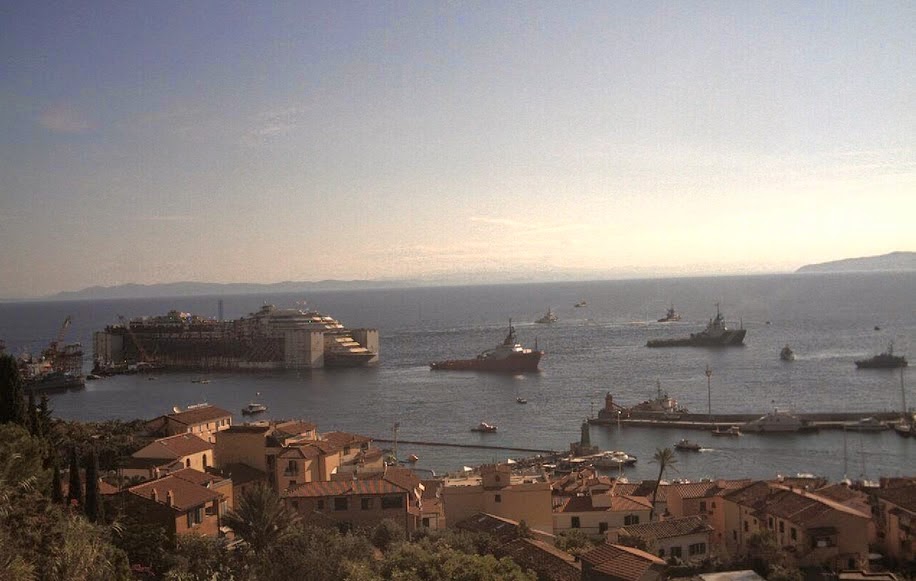

8h53 heure française


 Le bateau pompe salut le public massé sur la digue du port de Giglio un court instant et c'est le départ
pour environ 250 km de mer direction Nord.
 Les installations de renflouement sont presque disparues du paysage (sur la gauche). Ainsi se termine
mon hommage aux 32 victimes de ce naufrage. Un plongeur serait décédé pendant les opérations.
C'est le 13 janvier 2012 qu'a eu lieu ce dramatique événement.
Le Concordia de 300 mètres de long et 115000 tonnes soutenu par 30 caissons est bien parti pour sa nouvelle vie : la démolition dans le port de Gênes.
 http://www.marinetraffic.com/fr/ais/home/centerx:10.8947/centery:42.44763/zoom:8/mmsi:247359600
fin
Voici quelques photos en provenance de la WEBCAM :
http://www.giglionews.it/2010/02/24/webcam-giglio-porto-panoramica
(ce lien sera coupé prochainement pour laisser la place à une autre webcam).
8h43 heure française :
8h53 heure française
pour environ 250 km de mer direction Nord.
mon hommage aux 32 victimes de ce naufrage. Un plongeur serait décédé pendant les opérations.
C'est le 13 janvier 2012 qu'a eu lieu ce dramatique événement.
Le Concordia de 300 mètres de long et 115000 tonnes soutenu par 30 caissons est bien parti pour sa nouvelle vie : la démolition dans le port de Gênes.
fin
Inscription à :
Articles (Atom)