ARISS contact planned with ESA Space Camp, Fleetwood, UK
An ARISS educational radio contact is planned with ESA Space Camp, Rossall School, Fleetwood, UK.
The event is scheduled Tuesday July 29 at 14:01:13 UTC . It will be a telebridge contact operated by W6SRJ in California.
A video from the event will be webcast at:
Http://www.batc.tv/streams/arissuk/
The
contact will be broadcast on EchoLink AMSAT (node 101 377) and JK1ZRW
(node 277 208) Conference servers, as well as on IRLP Discovery
Reflector 9010.
This annual camp is organized by the ESA Space
Camp Committee takes place in a different European country each summer
for 2 weeks. This year the camp takes place between 27 July and 10
August where 185 young space explorers aged 8 to 17 will meet each other
in the UK at Rossall School. The children come from the following ESA
establishments (UK, France, Spain, Italy, The Netherlands and Germany).
This
will be the 20th Space Camp organised by ESA. This year the children
will also be involved in celebrating this milestone with marking 50
years of ESA. Children, their parents and educators from the area will
join the ESA campers on this special celebration day.
Rossall is a
boarding school situated on a beautiful 160-acre site, there is plenty
of room for extensive sports and cultural facilities, including a
swimming pool, squash and tennis courts, as well as a fitness room and a
climbing wall.
The ESC 2014 programme will feature a balanced
mix of sports such as flag rugby, lifeguarding, kayaking and martial
arts. The theme for camp will be ‘Reach for the Stars!’ Well-equipped IT
labs, classrooms and an on-site planetarium will be instrumental in
setting up a space education programme that will keep the children
motivated with new and exciting hands-on activities and educational
tasks involving space-related themes, as well as learning about the
culture of the host country.
As with all ESA Space Camps, there
will be specific emphasis placed on socialisation and respect among the
participants. We hope to make the camp a really unique experience for
juniors and teenagers who are in the process of becoming citizens of a
multicultural society.
This ARISS contact will mark a highlight in
the space education programme as children will be learning about many
aspects related to man’s endeavours to reach for the stars!
Students will ask as many of following questions as time allows:
1. Zachary (12): What has been your biggest challenge since being in space?
2.
Noemi (11): On Earth bubbles in sparkling water (or cola) float
upwards, but in the ISS, there is no up and down. Which direction do the
bubbles go in sparkling water (or cola) on the ISS?
3. Kai (9): If you could change one thing on the ISS, what would it be?
4. Caroline (8): How do you sleep and for how long?
5. Lisann (10): Do you need sunscreen in space?
6. Nassim (8): Why do we have plenty of oxygen on earth, but not enough in space?
7. Auriane (10): Do you see time passing by in space? Do you have the same feeling of time duration (days & nights)?
8.
William Baker (12): Can you give us an example of some added safety
procedures or precautions you must take in doing everyday tasks while on
the ISS?
9. Eduardo García (8): Why is there no oxygen outside the ISS?
10. Sonia ERNST: How long does it take to go around our planet?
11. Damien (9): What were your last thoughts when leaving earth?
12. Tristan (8): How do you keep your clothes clean on the Space Station with so little water?
13. Marie (8): Are there any seasons on the ISS?
14. Emil (8): What do you do for fun on the ISS?
15.
Charles (13): I have been fascinated by the film "Gravity”. How
realistic is the film? Is space crowded by debris and therefore so
dangerous?
16. Roxane (10): How many switches are there inside the spacecraft, and do you know what all of them do?
17. Andrew (13): Is it highly stressful to be in space?
18. Ella (9): How do you have a bath when the water goes everywhere?
19. Benjamin (11): How do you dispose of the waste?
20. Luca (13): How are medical surgeries done in space if a specialized doctor is not available?
21. Lena (11): How is it in the ISS, when you arrive the first time? Was the journey comfortable?
22. Giulio (10): What would you like to achieve that you haven't yet?
23.
Eveline (9): I've been practicing various types of sports the last
years, and now I still do judo. What sports can you practice in the
International Space Station, a weightless environment?
ARISS is
an international educational outreach program partnering the
participating space agencies, NASA, Russian Space Agency, ESA, CNES,
JAXA, and CSA, with the AMSAT and IARU organizations from participating
countries.
ARISS offers an opportunity for students to experience
the excitement of Amateur Radio by talking directly with crewmembers
onboard the International Space Station. Teachers, parents and
communities see, first hand, how Amateur Radio and crewmembers on ISS
can energize youngsters' interest in science, technology and learning.
73,
Gaston Bertels, ON4WF
ARISS Europe Chairman
Source directe / ARISS
f6agv (AT) free.fr

F6AGV : ACTUALITE du RADIO AMATEURISME
jeudi 24 juillet 2014
mercredi 23 juillet 2014
L' EPAVE du CONCORDIA REMORQUEE vers GENES le 23 juillet 2014
Ce matin du 23 juillet 2014 l'épave du Concordia a quitté son emplacement devant le port de Giglio, pour son dernier voyage vers Gênes où elle sera démontée :
Voici quelques photos en provenance de la WEBCAM :
http://www.giglionews.it/2010/02/24/webcam-giglio-porto-panoramica
(ce lien sera coupé prochainement pour laisser la place à une autre webcam).
8h43 heure française :
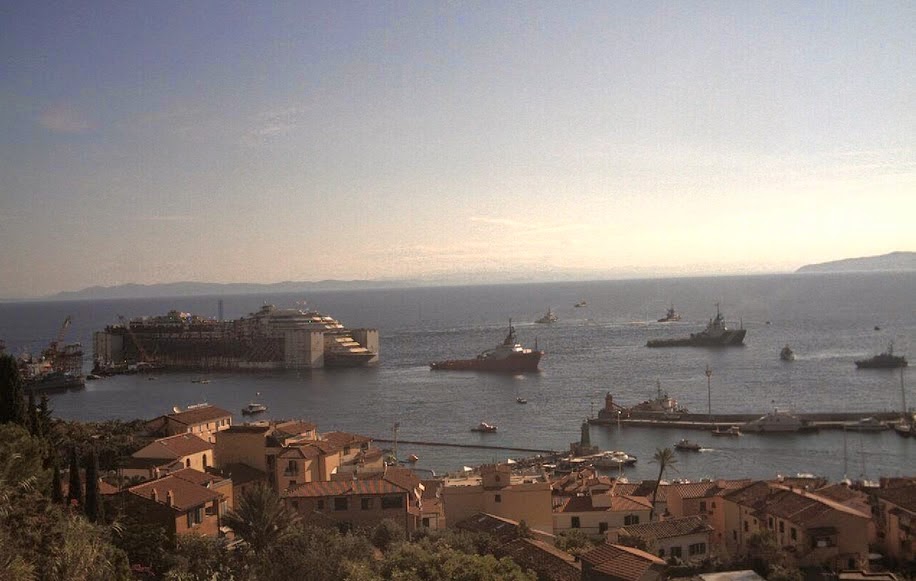

8h53 heure française


 Le bateau pompe salut le public massé sur la digue du port de Giglio un court instant et c'est le départ
pour environ 250 km de mer direction Nord.
 Les installations de renflouement sont presque disparues du paysage (sur la gauche). Ainsi se termine
mon hommage aux 32 victimes de ce naufrage. Un plongeur serait décédé pendant les opérations.
C'est le 13 janvier 2012 qu'a eu lieu ce dramatique événement.
Le Concordia de 300 mètres de long et 115000 tonnes soutenu par 30 caissons est bien parti pour sa nouvelle vie : la démolition dans le port de Gênes.
 http://www.marinetraffic.com/fr/ais/home/centerx:10.8947/centery:42.44763/zoom:8/mmsi:247359600
fin
Voici quelques photos en provenance de la WEBCAM :
http://www.giglionews.it/2010/02/24/webcam-giglio-porto-panoramica
(ce lien sera coupé prochainement pour laisser la place à une autre webcam).
8h43 heure française :
8h53 heure française
pour environ 250 km de mer direction Nord.
mon hommage aux 32 victimes de ce naufrage. Un plongeur serait décédé pendant les opérations.
C'est le 13 janvier 2012 qu'a eu lieu ce dramatique événement.
Le Concordia de 300 mètres de long et 115000 tonnes soutenu par 30 caissons est bien parti pour sa nouvelle vie : la démolition dans le port de Gênes.
fin

mardi 15 juillet 2014
L'EPAVE DU CONCORDIA va bientôt quitter Giglio.

webcam du 9 juillet 2014

webcam du 15 juillet 2014

Voir cette webcam en direct : http://www.giglionews.it/2010/02/24/webcam-giglio-porto-panoramica/
Le départ est pour cette semaine, si tout va bien. Dernière info : retard à cause de la météo, et des opérations non terminées. Il aurait lieu mardi 22 juillet, si tout va bien ?
L'opération de renflouement consiste maintenant à injecter de l'air dans les caissons répartis autour
de l'épave. Le pompage de l'eau à l'intérieur doit se faire simultanément.
En comparant les deux vues ci-dessus, il semble bien que le Concordia soit plus haut sur le niveau
de la mer.
Site intéressant 24/24 : http://www.leconcordia.fr/0005-renflouement.htm
A suivre,
SUCCESSFUL ARISS CONTACT IN DLR SCHOOL BRAUNSCHWEIG, GERMANY le 11 juillet 2014
SUCCESSFUL ARISS CONTACT IN DLR SCHOOL BRAUNSCHWEIG, GERMANY
Friday July 11, 2014 at 09:37 UTC, which is 11:37 local time, DLR School Lab, Braunschweig, Germany established a ARISS contacts with ESA
astronaut Alexander Gerst KF5ONO, onboard the International Space Station. This was a direct contact performed by Amateur radio ground station DN1DLR, located at school.
The German Aerospace Center (DLR) is one of Europe's largest and most modern research institutions. Here is where the aircraft of the future are being developed and pilots trained, rocket engines tested and images of distant planets analyzed. In addition, over 7,700 DLR staff members are investigating next-generation high-speed trains, environmentally responsible methods of generating energy, and much more...
DLR_School_Lab in Braunschweig investigates many topics related to transportation: whether on the road, rails, or in the air. In various experiments, school classes can acquaint themselves with the research topics being studied at the science institutes at DLR Braunschweig.
Mentor Francesco De Paolis IKØWGF proposed to the radio coordinators Mr. Michael Przybilla, DD2MIC and Mr. Niels Holger Siegmund DH1AL the direct contact supported by Telebridge Station IK1SLD and this was accepted. About 150 students, parents, visitors and media attended the event at contact site.
Contact was established at 09:37 UTC, which is 11:37 CEST local time, with DPØISS. Astronaut Alexander Gerst KF5ONO answered 13 questions by students. Signals from the ISS was loud and clear during all ISS pass.
NDR Television, 3 radio broadcaster, local media and 5 newspapers covered the event.
Here two tv reports on NDR:
https://www.ndr.de/fernsehen/sendungen/hallo_niedersachsen/Funkkontakt-mit-deutschem-Astronauten-auf-ISS,hallonds22506.html
https://www.ndr.de/fernsehen/sendungen/niedersachsen_1800/Niedersachsen-1800-Uhr,sendung252830.html
The event was on DLR Portal: http://www.dlr.de/schoollab/desktopdefault.aspx/tabid-5806/9439_read-40551/
DARC (Germany's Amateur Radio Club) has an article on its main page:
http://www.darc.de/ and
http://www.darc.de/aktuelles/details/article/braunschweiger-schule-nimmt-kontakt-zur-iss-auf/
Congratulations to ARISS DLR Team and II1SLD Team!
73
Francesco De Paolis, IKØWGF
ARISS Mentor
Source directe : ARISS
f6agv (AT) free.fr
Friday July 11, 2014 at 09:37 UTC, which is 11:37 local time, DLR School Lab, Braunschweig, Germany established a ARISS contacts with ESA
astronaut Alexander Gerst KF5ONO, onboard the International Space Station. This was a direct contact performed by Amateur radio ground station DN1DLR, located at school.
The German Aerospace Center (DLR) is one of Europe's largest and most modern research institutions. Here is where the aircraft of the future are being developed and pilots trained, rocket engines tested and images of distant planets analyzed. In addition, over 7,700 DLR staff members are investigating next-generation high-speed trains, environmentally responsible methods of generating energy, and much more...
DLR_School_Lab in Braunschweig investigates many topics related to transportation: whether on the road, rails, or in the air. In various experiments, school classes can acquaint themselves with the research topics being studied at the science institutes at DLR Braunschweig.
Mentor Francesco De Paolis IKØWGF proposed to the radio coordinators Mr. Michael Przybilla, DD2MIC and Mr. Niels Holger Siegmund DH1AL the direct contact supported by Telebridge Station IK1SLD and this was accepted. About 150 students, parents, visitors and media attended the event at contact site.
Contact was established at 09:37 UTC, which is 11:37 CEST local time, with DPØISS. Astronaut Alexander Gerst KF5ONO answered 13 questions by students. Signals from the ISS was loud and clear during all ISS pass.
NDR Television, 3 radio broadcaster, local media and 5 newspapers covered the event.
Here two tv reports on NDR:
https://www.ndr.de/fernsehen/sendungen/hallo_niedersachsen/Funkkontakt-mit-deutschem-Astronauten-auf-ISS,hallonds22506.html
https://www.ndr.de/fernsehen/sendungen/niedersachsen_1800/Niedersachsen-1800-Uhr,sendung252830.html
The event was on DLR Portal: http://www.dlr.de/schoollab/desktopdefault.aspx/tabid-5806/9439_read-40551/
DARC (Germany's Amateur Radio Club) has an article on its main page:
http://www.darc.de/ and
http://www.darc.de/aktuelles/details/article/braunschweiger-schule-nimmt-kontakt-zur-iss-auf/
Congratulations to ARISS DLR Team and II1SLD Team!
73
Francesco De Paolis, IKØWGF
ARISS Mentor
Source directe : ARISS
f6agv (AT) free.fr
mercredi 9 juillet 2014
PROGRAMME de RELAIS écrit pour F1ZFM en 2011
'{$stamp bs2}
'debug "relais F1ZFM"
DIRS=00000001111111
teste:
high 14
pause 1000
low 14
high 13
pause 1000
low 13
high 12
pause 1000
low 12
high 10
pause 1000
low 10
high 11
pause 1000
low 11
high 15
pause 1000
low 15
'goto teste
'declarations
e var nib
f var nib
d var word
tp var word
sa var bit
g var nib
a var nib
qso var bit
r var nib
n var nib
t var word
c var nib
p var nib
mm var bit
kk var bit
i var nib
ec var nib
depart:
e = 0
f= 0
sa = 0
g = 0
a = 0
tp = 0
n = 0
qso = 0
c = 0
p = 0
mm = 0
i = 0
r = 0
ec = 0
debut:
low 15
low 14
e = 0
f = 0
a = 0
qso = 0
p = 0
tp = 0
r = 0
batrec:
input 0
if in0 = 1 then temp3
input 5
if in5 = 1 then balise1
input 3
if in3 = 1 then artel
input 7
if in7 = 1 then intro
goto batrec
temp3:
pause 3000
input 0
if in0 = 1 then perma
goto batrec
perma:
input 0
if in0 = 1 then vere
intro:
pause 500
debug "intro", 10,13
intro2:
input 0
if in0 = 1 then perma
input 1
if in1 = 1 then intro3
goto verf
intro3:
input 2
if in2 = 1 then verf
goto intro4
verf:
f=f+1
debug "f=", dec f," "
pause 1000
if f >= 8 then vpun2
goto intro2
vpun2:
d=d+1
debug "d=", dec d, 10,13
goto puni2
vere:
e=e+1
debug "e=", dec e, " "
pause 1000
if e >= 8 then vpun1
goto perma
vpun1:
e=0
goto puni1
intro4:
debug "intro4",10,13
pause 100
input 1
if in1 = 1 then intro5
goto verf
intro5:
input 2
if in2 = 1 then verf
intro6:
input 0
if in0 = 1 then perma
rxtx:
debug "rxtx",10,13
high 15
high 13
high 14
pause 100
low 13
tp = 0
a = 0
bateme:
input 4
if in4 = 1 then supab1
batem1:
input 3
if in3 = 1 then artel
input 6
if in6 = 1 then bavard
input 5
if in5 = 1 then balise4
input 0
if in0 = 1 then coup
input 1
if in1 = 1 then mdul
input 2
if in2 = 1 then pnm
if qso = 0 then vtimid
tempospe:
if r = 0 then cts
for t = 1 to 10
debug "tempospe=", dec t, " "
input 1
if in1 = 1 then bateme
input 2
if in2 = 1 then bateme
pause 100
next
cts:
input 1
if in1 = 1 then bateme
input 2
if in2 = 1 then bateme
if tp >= 4 then suite
c=c+1
kk=1
debug "c=", dec c, " "
if c>=4 then cana
'bip
debug "bip",10,13
pause 500
cnrd:
p = 0
qso = 0
goto bateme
cana:
if c >=16 then puni6
goto cnrd
supab1:
sa = 1
debug "sa=1",10,13
'point inter
debug "?",10,13
pause 500
goto batem1
artel:
high 15
low 14
pause 1000
'indicatif
debug "indic",10,13
pause 1000
low 15
mate:
input 4
if in4 = 1 then cartel
goto mate
cartel:
high 15
low 14
pause 1000
'indicatif
debug "indic",10,13
pause 1000
low 15
goto depart
bavard:
if sa = 1 then razab1
avert:
'3 bips
debug "3bips",10,13
pause 500
a = a + 1
debug "a=", dec a, " "
if a>=8 then absor
input 0
if in0 = 1 then avert
input 1
if in1 = 1 then avert
input 2
if in2 = 1 then avert
high 12
pause 3000
low 12
'k
debug "k",10,13
pause 500
goto bateme
razab1:
high 12
pause 3000
low 12
'r
debug "r",10,13
pause 500
goto bateme
absor:
pause 1000
high 15
low 14
pause 1000
'hi
debug "hi",10,13
pause 500
goto puni4
coup:
pause 1000
input 0
if in0 = 1 then ccoup
goto bateme
ccoup:
g=g+1
debug "g=", dec g, " "
if g >=2 then cccp
coup1:
'point intero
debug "?",10,13
pause 500
goto bateme
cccp:
if g>=4 then puni3
goto bateme
mdul:
qso = 1
debug "qso=1",10,13
r=0
if kk=0 then ctp
tp = 0
ctp:
'compteur tp soft
tp = tp + 1
pause 1000
debug "tp=" ,dec tp, " "
kk=0
goto bateme
pnm:
debug "pnm", 10,13
pause 1000
input 2
if in2 = 1 then cpnm
goto bateme
cpnm:
n=n+1
debug "n=", dec n, " "
'2 bips
debug "2bips",10,13
pause 500
if n >= 15 then puni7
goto bateme
vtimid:
pause 3000
p=p+1
debug "p=", dec p, " "
if p = 4 then ctimid
goto timid
ctimid:
'point intero
debug "?",10,13
pause 500
timid:
if p >= 8 then dtimid
goto bateme
dtimid:
high 15
low 14
if mm = 0 then etimid
i = i + 1
debug "i=", dec i, " "
if i >= 2 then puni5
low 15
goto debut
etimid:
mm = 1
'musique
debug "music",10,13
pause 500
low 15
goto debut
balise1:
high 15
low 14
pause 1000
'indicatif
debug "indic",10,13
pause 1000
'qra locator
debug "qra",10,13
pause 1000
low 15
low 14
goto debut
balise4:
high 15
low 14
input 1
if in1 = 1 then rxtx
input 2
if in2 = 1 then rxtx
pause 1000
'indicatif
debug "balis4",10,13
pause 1000
'qra locator
goto rxtx
suite:
g=0
n=0
r=r+1
debug "r=", dec r, " "
if r = 1 then senk
if r >=10 then fini
pause 3000
goto rxtx
fini:
high 15
low 14
i = 0
ec = 0
c = 0
mm = 0
n = 0
if tp >= 30 then inmus
quite:
low 15
low 14
goto debut
inmus:
if tp >= 60 then mus
'indicatif
debug "indic",10,13
pause 1000
goto quite
mus:
'musique
debug "music",10,13
pause 1000
'indicatif
debug "indic",10,13
pause 1000
goto quite
senk:
high 15
high 14
kk=1
if tp >=8 then sm
csenk:
if sa = 1 then sendr
'k
debug "k",10,13
goto rxtx
sendr:
'r
debug "r",10,13
goto rxtx
sm:
high 11
debug "SM-ON",10,13
pause 1000
low 11
c=0
goto csenk
puni1:
'sortie1
debug "p1",10,13
goto puni
puni2:
'sortie2
debug "p2",10,13
goto puni
puni3:
'sortie3
debug "p3",10,13
goto puni
puni4:
'sortie4
debug "p4",10,13
goto puni
puni5:
'sortie5
debug "p5",10,13
goto puni
puni6:
'sortie6
debug "p6",10,13
goto puni
puni7:
'sortie7
debug "p7",10,13
puni:
debug "puni",10,13
low 15
low 14
ec = ec + 1
debug "ec=", dec ec, " "
if ec = 1 then point1
for t = 1 to 60
debug "tpuni=", dec t, " "
pause 1000
next
'600 pour 10 mn
punout:
input 5
if in5 = 1 then cpoint
input 0
if in0 = 1 then chit
goto punout
point1:
pause 3000
c=0
n=0
a=0
goto balise1
cpoint:
ec=1
goto point1
chit:
if ec >=3 then debut
high 15
'hit
debug "hit",10,13
pause 1000
low 15
goto debut
'version 110911 V3.1.5
'prog by F6AGV 2011
f6agv (AT) free.fr
dimanche 6 juillet 2014
ANTENNE EXPERIMENTALE pour le 40 mètres intérieure !

A titre expérimental, et après tout, on est autorisé pour essayer des solutions originales, j'ai installé
une antenne sous la toiture (charpente bois et tuiles).
Le dipôle fait exactement 6,6 m et 13,42 m, avec une boite de raccordement présentant un socle SO239.
Sous l'antenne à 2,5 mètres et sous la charpente, il y a les ferrures en acier qui vont supporter les plaques de BA13 du futur plafond. La longueur est de 15 mètres dans la réalité, mais dans les calculs, elle est fixée à 20 mètres. Voir le schéma ci-dessus.
Que donnent les calculs :

Le ROS est raisonnable et dans la pratique, j'obtiens exactement 1,0 avec un câble coaxial de 50 ohms.
Le diagramme est omnidirectionnel et l'angle de départ intéressant.
Que donne l'utilisation :
La puissance est celle fournie par un IC-706 MK2G sans coupleur (100 watts).
Le ROS est surveillé avec un appareil à deux cadrans classique.
Les reports sont bons, dans toutes les directions et suivant "dame propagation", il n' y a pas de problème
pour se faire entendre dans les QSO même multiples. Les stations arrivent parfois à fond de S-Mètre.
Je ne sais pas si c'est une solution définitive mais par rapport à un dipôle simple qui aurait une perte de signal dans l'axe, ça demande encore à être testé.La direction du fil est Est - Ouest.
Ma fréquence habituelle est le 7,103 MHz sur laquelle j'écoute le plus souvent en bricolant dans le shack !
Peut-être aurons nous le plaisir de nous contacter sur la bande 40 mètres !
73 Alain F6AGV
samedi 5 juillet 2014
SUCCESSFUL ARISS CONTACT le 2 juillet 2014
SUCCESSFUL ARISS CONTACT IN DLR SCHOOL NEUSTRELITZ, GERMANY
Wednesday July 2, 2014 at 12:05 UTC, which is 14:05 local time, DLR Project Lab, Neustrelitz, Germany established an ARISS contacts with ESA astronaut Alexander Gerst KF5ONO, onboard the International Space Station. This was a direct contact performed by Amateur radio ground station DN1BV, located in the school.
The German Aerospace Center (DLR) is one of Europe's largest and most modern research institutions. Here is where the aircraft of the future are being developed and pilots trained, rocket engines tested and images of distant planets analyzed. In addition, over 7,700 DLR staff members are investigating next-generation high-speed trains, environmentally responsible methods of generating energy, and much more ...
DLR_School_Lab Neustrelitz was opened in September 2011 at DLR in Neustrelitz in Mecklenburg-Vorpommern. Here is where the data from various satellites are received by means of large antennas, and subsequently processed. The student lab is available for visits of one or several days by school classes from this most northerly German state and further afield.
Mentor Francesco De Paolis IKØWGF proposed to the radio coordinators Wolfgang Andree DH5NA and Ingo Goltz DL1BLV to support the direct contact by Telebridge Station IK1SLD and this was accepted. About 100 students, parents, visitors and media attended the event at contact site.
Contact was established with OR4ISS at 12:05 UTC, which is 14:05 CEST local time. Astronaut Alexander Gerst KF5ONO answered 15 questions asked by students. Signals from the ISS were loud and clear during all ISS pass.
N3 TV Mecklenburg-Vorpommern and Regional Television, local media and newspapers covered the event.
Streaming video on: www.livestream.com/iss_dsl_nz
The video of the contact is available here: http://livestre.am/4Tp7r
The event was announced on DLR Portal: http://www.dlr.de/schoollab/desktopdefault.aspx/tabid-5806/9439_read-40261/
Congratulations to ARISS DLR Team and IK1SLD Team!
73
Francesco De Paolis, IKØWGF
ARISS Mentor
Source directe ARISS
f6agv (AT) free.fr
Wednesday July 2, 2014 at 12:05 UTC, which is 14:05 local time, DLR Project Lab, Neustrelitz, Germany established an ARISS contacts with ESA astronaut Alexander Gerst KF5ONO, onboard the International Space Station. This was a direct contact performed by Amateur radio ground station DN1BV, located in the school.
The German Aerospace Center (DLR) is one of Europe's largest and most modern research institutions. Here is where the aircraft of the future are being developed and pilots trained, rocket engines tested and images of distant planets analyzed. In addition, over 7,700 DLR staff members are investigating next-generation high-speed trains, environmentally responsible methods of generating energy, and much more ...
DLR_School_Lab Neustrelitz was opened in September 2011 at DLR in Neustrelitz in Mecklenburg-Vorpommern. Here is where the data from various satellites are received by means of large antennas, and subsequently processed. The student lab is available for visits of one or several days by school classes from this most northerly German state and further afield.
Mentor Francesco De Paolis IKØWGF proposed to the radio coordinators Wolfgang Andree DH5NA and Ingo Goltz DL1BLV to support the direct contact by Telebridge Station IK1SLD and this was accepted. About 100 students, parents, visitors and media attended the event at contact site.
Contact was established with OR4ISS at 12:05 UTC, which is 14:05 CEST local time. Astronaut Alexander Gerst KF5ONO answered 15 questions asked by students. Signals from the ISS were loud and clear during all ISS pass.
N3 TV Mecklenburg-Vorpommern and Regional Television, local media and newspapers covered the event.
Streaming video on: www.livestream.com/iss_dsl_nz
The video of the contact is available here: http://livestre.am/4Tp7r
The event was announced on DLR Portal: http://www.dlr.de/schoollab/desktopdefault.aspx/tabid-5806/9439_read-40261/
Congratulations to ARISS DLR Team and IK1SLD Team!
73
Francesco De Paolis, IKØWGF
ARISS Mentor
Source directe ARISS
f6agv (AT) free.fr
vendredi 4 juillet 2014
ARISS le 11 juillet en Allemagne
ARISS contact planned Friday July 11, 2014 with school in Braunschweig, Germany
An ARISS contact is planned Friday July 11, 2014 at 09:37:47 UTC, which is 11:37:47 CEST. ESA astronaut Alexander Gerst KF5ONO will answer questions from students at DLR School Lab, Braunschweig, Germany.
Signals from the ISS will be audible over Europe on 145.800 FM.
The German Aerospace Center (DLR) is one of Europe's largest and most modern research institutions. Here is where the aircraft of the future are being developed and pilots trained, rocket engines tested and images of distant planets analyzed. In addition, over 7,700 DLR staff members are investigating next-generation high-speed trains, environmentally responsible methods of generating energy, and much more ...
DLR_School_Lab in Braunschweig investigates many topics related to transportation: whether on the road, rails, or in the air. In various experiments, school classes can acquaint themselves with the research topics being studied at the science institutes at DLR Braunschweig.
The contact will be conducted in German.
Participants will ask as many of the following questions as time allows:
1. Alexander (17). Dürfen Sie in ihrer Freizeit Weltraumspaziergänge machen?
2. Anja (17). Was ist das Schönste daran, im Weltraum zu sein?
3. Clemens (18). Wie bzw. was war Ihr erster Eindruck in der ISS?
4. Kristopher (16). Woran dachten Sie unmittelbar bevor Sie in den Weltraum geflogen sind?
5. Johannes (17). Was wollten Sie schon immer im Weltraum machen?
6. Noah (16). Helfen Ihnen Ihre Erfahrungen aus der Antarktis weiter?
7. Marvin (17). Vermissen Sie die Schwerkraft in manchen Situationen?
8. Gerrit (18). Ist die Vorbereitung unter Wasser gleich der "echten" Schwerelosigkeit? Wenn nicht, wie ist es anders?
9. Johannes (16). Herr Gerst, wie war das Andock-Manöver für Sie persönlich? Und in wie fern waren Sie daran beteiligt?
10. Erik (17). Wie verhält sich Feuer in der Schwerelosigkeit?
11. Tim (17). Wie schützt man sich vor der Weltraumstrahlung?
12. Lea (17). Was war das erste, was Sie getan haben, als zum ersten Mal die Schwerkraft aussetzte?
13. Patricia (18). Wie fühlt es sich an, wenn man an der Raumkrankeit leidet?
14. Philipp (18). Was werden Sie als Geophysiker im Weltraum testen? Was werden Ihre Hauptaufgaben sein?
15. Steffen (17). Werden die Ergebnisse der Experimente untereinander ausgetauscht, oder bleiben Sie geheim?
16. Yannik (17). Ist der Job im All gut bezahlt?
17. Viktor (17). Kann man im Weltraum heiraten? Wenn ja, in welchem Land wäre die Vermählung eingetragen?
18. Lukas (18). Wie werden Krankheiten oder Infektionen im Weltall behandelt? Variieren sie von denen auf der Erde?
19. Tilman (18). War Astronaut schon immer Ihr Traumberuf?
20. Steffen (17). Hat man trotz den zweistündigen täglichen Trainings Muskelschwund?
ARISS is an international educational outreach program partnering the participating space agencies, NASA, Russian Space Agency, ESA, CNES, JAXA, and CSA, with the AMSAT and IARU organizations from participating countries.
ARISS offers an opportunity for students to experience the excitement of Amateur Radio by talking directly with crewmembers onboard the International Space Station. Teachers, parents and communities see, first hand, how Amateur Radio and crewmembers on ISS can energize youngsters' interest in science, technology and learning.
73,
Gaston Bertels, ON4WF
ARISS Europe Chairman
Source directe ARISS
f6agv (at) free.fr
An ARISS contact is planned Friday July 11, 2014 at 09:37:47 UTC, which is 11:37:47 CEST. ESA astronaut Alexander Gerst KF5ONO will answer questions from students at DLR School Lab, Braunschweig, Germany.
Signals from the ISS will be audible over Europe on 145.800 FM.
The German Aerospace Center (DLR) is one of Europe's largest and most modern research institutions. Here is where the aircraft of the future are being developed and pilots trained, rocket engines tested and images of distant planets analyzed. In addition, over 7,700 DLR staff members are investigating next-generation high-speed trains, environmentally responsible methods of generating energy, and much more ...
DLR_School_Lab in Braunschweig investigates many topics related to transportation: whether on the road, rails, or in the air. In various experiments, school classes can acquaint themselves with the research topics being studied at the science institutes at DLR Braunschweig.
The contact will be conducted in German.
Participants will ask as many of the following questions as time allows:
1. Alexander (17). Dürfen Sie in ihrer Freizeit Weltraumspaziergänge machen?
2. Anja (17). Was ist das Schönste daran, im Weltraum zu sein?
3. Clemens (18). Wie bzw. was war Ihr erster Eindruck in der ISS?
4. Kristopher (16). Woran dachten Sie unmittelbar bevor Sie in den Weltraum geflogen sind?
5. Johannes (17). Was wollten Sie schon immer im Weltraum machen?
6. Noah (16). Helfen Ihnen Ihre Erfahrungen aus der Antarktis weiter?
7. Marvin (17). Vermissen Sie die Schwerkraft in manchen Situationen?
8. Gerrit (18). Ist die Vorbereitung unter Wasser gleich der "echten" Schwerelosigkeit? Wenn nicht, wie ist es anders?
9. Johannes (16). Herr Gerst, wie war das Andock-Manöver für Sie persönlich? Und in wie fern waren Sie daran beteiligt?
10. Erik (17). Wie verhält sich Feuer in der Schwerelosigkeit?
11. Tim (17). Wie schützt man sich vor der Weltraumstrahlung?
12. Lea (17). Was war das erste, was Sie getan haben, als zum ersten Mal die Schwerkraft aussetzte?
13. Patricia (18). Wie fühlt es sich an, wenn man an der Raumkrankeit leidet?
14. Philipp (18). Was werden Sie als Geophysiker im Weltraum testen? Was werden Ihre Hauptaufgaben sein?
15. Steffen (17). Werden die Ergebnisse der Experimente untereinander ausgetauscht, oder bleiben Sie geheim?
16. Yannik (17). Ist der Job im All gut bezahlt?
17. Viktor (17). Kann man im Weltraum heiraten? Wenn ja, in welchem Land wäre die Vermählung eingetragen?
18. Lukas (18). Wie werden Krankheiten oder Infektionen im Weltall behandelt? Variieren sie von denen auf der Erde?
19. Tilman (18). War Astronaut schon immer Ihr Traumberuf?
20. Steffen (17). Hat man trotz den zweistündigen täglichen Trainings Muskelschwund?
ARISS is an international educational outreach program partnering the participating space agencies, NASA, Russian Space Agency, ESA, CNES, JAXA, and CSA, with the AMSAT and IARU organizations from participating countries.
ARISS offers an opportunity for students to experience the excitement of Amateur Radio by talking directly with crewmembers onboard the International Space Station. Teachers, parents and communities see, first hand, how Amateur Radio and crewmembers on ISS can energize youngsters' interest in science, technology and learning.
73,
Gaston Bertels, ON4WF
ARISS Europe Chairman
Source directe ARISS
f6agv (at) free.fr
dimanche 29 juin 2014
ARISS le 2 juillet 2014
ARISS contact planned Wednesday July 2, 2014 with school in Germany
An ARISS contact is planned Wednesday July 2, 2014 at 12:05:13 UTC, which is 14:05:13 CEST.
ESA astronaut Alexander Gerst KF5ONO will answer questions from students at DLR Project Lab, Neustrelitz, Germany.
Signals from the ISS will be audible over Europe on 145.800 FM.
The German Aerospace Center (DLR) is one of Europe's largest and most modern research institutions. Here is where the aircraft of the future are being developed and pilots trained, rocket engines tested and images of distant planets analyzed. In addition, over 7,700 DLR staff members are investigating next-generation high-speed trains, environmentally responsible methods of generating energy, and much more ...
DLR_School_Lab Neustrelitz was opened in September 2011 at DLR in Neustrelitz in Mecklenburg-Vorpommern. Here is where the data from various satellites are received by means of large antennas, and subsequently processed. The student lab is available for visits of one or several days by school classes from this most northerly German state and further afield.
The contact will be conducted in German.
Participants will ask as many of the following questions as time allows:
1. Saskia: Man kann nicht einfach von der ISS auf die Erde zurück. Ist Heimweh für Sie ein Thema?
2. Christoph: Haben Sie einen Talisman mit auf die ISS genommen?
3. Saskia: Wie empfinden Sie das Gefühl der Schwerelosigkeit?
4. Lena: Was passiert, wenn man auf der ISS Wasser ausschüttet?
5. Paul: Wie funktionieren die Duschen auf der ISS?
6. Justin: Wie viele Stunden Schlaf haben Sie und wie lange müssen Sie am Tag arbeiten?
7. Alexander: Verspüren Sie nach sportlicher Aktivität im Orbit Muskelkater wie auf der Erde?
8. Andrè: Konnten Sie von der ISS aus schon Polarlichter beobachten?
9. Nicklas: Können Sie von der ISS aus für unser Schülerlabor ein tolles Foto von der Erde aufnehmen?
10. Lena: Seit wann sind Sie Amateurfunker?
11. Florian: Wie und zu welcher Zeit nehmen Sie Kontakt zu Ihrer Familie auf.
12. Oskar: Gibt es bestimmte Krankheiten, die man nur im All bekommen kann.
13. Catharina: Wie lange wird Ihr Rückflug zur Erde dauern?
14. Raphael: Haben Sie bereits Pläne für die Zeit nach der ISS?
15. Leon: Träumt man während des Schlafes im All anders als auf der Erde?
16. Richard: Welches Gefühl hatten Sie beim Betreten der ISS?
17. Florian: Auf welchen Frequenzbändern findet die Kommunikation mit der Erde statt?
18. Florian: Kann man sich bei einem Außeneinsatz im Weltraum erkälten?
19. Paul: Stellt radioaktive Strahlung eine Gefahr bei Außeneinsätzen dar?
20. Lea: Schmeckt das Essen auf der ISS anders als auf der Erde?
ARISS is an international educational outreach program partnering the participating space agencies, NASA, Russian Space Agency, ESA, CNES, JAXA, and CSA, with the AMSAT and IARU organizations from participating countries.
ARISS offers an opportunity for students to experience the excitement of Amateur Radio by talking directly with crewmembers onboard the International Space Station. Teachers, parents and communities see, first hand, how Amateur Radio and crewmembers on ISS can energize youngsters' interest in science, technology and learning.
73,
Gaston Bertels, ON4WF
ARISS Europe Chairman
Source directe : ARISS
f6agv (AT) free.fr
An ARISS contact is planned Wednesday July 2, 2014 at 12:05:13 UTC, which is 14:05:13 CEST.
ESA astronaut Alexander Gerst KF5ONO will answer questions from students at DLR Project Lab, Neustrelitz, Germany.
Signals from the ISS will be audible over Europe on 145.800 FM.
The German Aerospace Center (DLR) is one of Europe's largest and most modern research institutions. Here is where the aircraft of the future are being developed and pilots trained, rocket engines tested and images of distant planets analyzed. In addition, over 7,700 DLR staff members are investigating next-generation high-speed trains, environmentally responsible methods of generating energy, and much more ...
DLR_School_Lab Neustrelitz was opened in September 2011 at DLR in Neustrelitz in Mecklenburg-Vorpommern. Here is where the data from various satellites are received by means of large antennas, and subsequently processed. The student lab is available for visits of one or several days by school classes from this most northerly German state and further afield.
The contact will be conducted in German.
Participants will ask as many of the following questions as time allows:
1. Saskia: Man kann nicht einfach von der ISS auf die Erde zurück. Ist Heimweh für Sie ein Thema?
2. Christoph: Haben Sie einen Talisman mit auf die ISS genommen?
3. Saskia: Wie empfinden Sie das Gefühl der Schwerelosigkeit?
4. Lena: Was passiert, wenn man auf der ISS Wasser ausschüttet?
5. Paul: Wie funktionieren die Duschen auf der ISS?
6. Justin: Wie viele Stunden Schlaf haben Sie und wie lange müssen Sie am Tag arbeiten?
7. Alexander: Verspüren Sie nach sportlicher Aktivität im Orbit Muskelkater wie auf der Erde?
8. Andrè: Konnten Sie von der ISS aus schon Polarlichter beobachten?
9. Nicklas: Können Sie von der ISS aus für unser Schülerlabor ein tolles Foto von der Erde aufnehmen?
10. Lena: Seit wann sind Sie Amateurfunker?
11. Florian: Wie und zu welcher Zeit nehmen Sie Kontakt zu Ihrer Familie auf.
12. Oskar: Gibt es bestimmte Krankheiten, die man nur im All bekommen kann.
13. Catharina: Wie lange wird Ihr Rückflug zur Erde dauern?
14. Raphael: Haben Sie bereits Pläne für die Zeit nach der ISS?
15. Leon: Träumt man während des Schlafes im All anders als auf der Erde?
16. Richard: Welches Gefühl hatten Sie beim Betreten der ISS?
17. Florian: Auf welchen Frequenzbändern findet die Kommunikation mit der Erde statt?
18. Florian: Kann man sich bei einem Außeneinsatz im Weltraum erkälten?
19. Paul: Stellt radioaktive Strahlung eine Gefahr bei Außeneinsätzen dar?
20. Lea: Schmeckt das Essen auf der ISS anders als auf der Erde?
ARISS is an international educational outreach program partnering the participating space agencies, NASA, Russian Space Agency, ESA, CNES, JAXA, and CSA, with the AMSAT and IARU organizations from participating countries.
ARISS offers an opportunity for students to experience the excitement of Amateur Radio by talking directly with crewmembers onboard the International Space Station. Teachers, parents and communities see, first hand, how Amateur Radio and crewmembers on ISS can energize youngsters' interest in science, technology and learning.
73,
Gaston Bertels, ON4WF
ARISS Europe Chairman
Source directe : ARISS
f6agv (AT) free.fr
lundi 23 juin 2014
DETECTEUR D'ORAGE INFLUENCE ELECTROSTATIQUE
Détecteur
d'orage, influence électrostatique
par
Alain F6AGV
Une
description plus détaillée sera proposée sur le site ballon
solaire. Le
détecteur sera développé comme un capteur électrostatique de charges
électriques. Ici le détecteur sera un accessoire pour la station radio, qui
donnera l'alarme en cas de menaces de perturbations orageuses. Le système
sera très utile car il avertit longtemps à l'avance de l'arrivée de charges
électriques dans l'atmosphère, même si le temps ne paraît pas orageux,
même si il n'y a aucun nuage dans le ciel. Un
coup d'oeil sur le baromètre pourrait être nécessaire pour confirmer ou
infirmer la menace. Une chute brutale de la pression est un signe fiable. Le
détecteur réagit de façon "spectaculaire" dans le cas de :
---
présence d'un orage à plusieurs dizaines ou centaines de kilomètres. Les
éclairs provoquent une déviation rapide du galvanomètre ( sauts brusques ).
---
nuages chargés d'électricités ( ions ).
---
pluies électrisées.
 |
 |
 |
La
sortie tension peut se diriger vers une alarme à relais, ou vers un
enregistrement, par exemple vers une station météo. Beaucoup de
possibilités sont permises avec ce détecteur. Il peut servir aussi à
détecter toutes charges électriques dangereuses dans la station radio qui
pourrait provoquer des dommages électriques sur les appareils. Les meilleurs
résultats sont obtenus en plaçant le détecteur à l'extérieur, car à
l'intérieur d'une habitation il y a de très nombreuses sources
d'électricité statique. ( moquette, matières plastiques, chemises nylon,
stylo, lunettes... ). Le meilleur
moyen pour tester le détecteur est de frotter une bouteille d'eau en
plastique vide et sèche avec un chiffon ou sur un vêtement. Dans ce cas la distance d'action
du détecteur est normalement de plusieurs mètres, il est bon de bien repérer la déviation du
détecteur, pour s'assurer qu'il fonctionne toujours parfaitement.
Principe
de base :
L'élément
est un transistor à effet de champ canal N, du type JFET ( transistor à
effet de champ ). Son prix est modique, au alentour de 0,6 euro, il est
préférable d'en acquérir une petite quantité pour expérimenter plusieurs
montages de détecteur. Les trois électrodes de ce transistor sont :
---
la source marquée S : d'où partent les électrons dans le composant. Les
électrons circulent dans une boucle ( voir schéma ).
---
le drain marqué D : qui attire les électrons vers la polarité positive de
l'alimentation.
---
la grille ou porte marquée G : qui commande le débit des électrons dans le
composant.
Caractéristiques
:

Il
n'est pas nécessaire de relever la caractéristique du transistor pour
l'utiliser, mais il est préférable de comprendre comment il fonctionne. La
caractéristique ressemble à celle d'une triode à tube mais avec une tension
d'alimentation beaucoup plus réduite. Le courant dans la grille est très
faible ( de l'ordre de 10-12 ) car la résistance d'entrée du
transistor est énorme, c'est ce qui fait son principal intérêt.
On
va supposer que la tension d'alimentation Vds est fixe, par exemple + 9V. Le
courant Id n'est pas un courant de court-circuit ! Il est mesuré
à une valeur de 10 mA maximum par exemple. Cela prouve que le transistor entre
ses broches D et S, peut être assimilé à une "résistance", il y a bien une
limitation du courant !
Si
la résistance devient variable, comme avec un rhéostat ou un potentiomètre,
alors le courant peut varier entre 0 et un maximum de 10 mA. Ne pas dépasser ce
maximum. Comment faire varier la résistance ? C'est le rôle de la grille G,
on va appliquer une tension négative variable entre G et S. Supposons que
nous avons Vds égal à +9 V fixe, on fait varier la tension de grille de 0 à - 5
volts ( voir graphique caractéristique ci-dessus ), le courant va donc varier
de 10 mA à zéro.
On
peut écrire avec la loi d'ohm : Id = Vds / Rds on
peut déduire :
Rds varie ------> Id varie.
Cette
propriété va servir dans notre détecteur. Il faut encore donner quelques
explications simples sur l'électricité statique : ( parfois connues )
---
Les électrons sont des particules chargées négativement.
---
Les électrons peuvent évoluer en dehors des atomes, alors ils sont dits
"libres".
---
Les électrons libres sont parfois accumulés dans des zones isolantes, c'est
l'électricité "statique". On parle de charges électrostatiques.
---
Les électrons libres peuvent circuler en boucle de courant, c'est le courant
électrique en circuit fermé, mesuré par son débit en ampères.
---
Les charges électrostatiques sont négatives quand elles sont composées d'un
certain nombre d'électrons libres.
---
Les charges électrostatiques sont déclarées positives dans le cas où ils
manquent des électrons libres sur une zone ou un corps.
---
Les charges négatives se repoussent. Les charges positives se repoussent. Les
charges de signes contraires s'attirent.
---
Un conducteur électrique non branché possède des électrons libres en
mouvement, il est chargé ou neutre.
Schéma
du détecteur :

Comment
ça marche ? Quand on frotte un morceau de plastique ( ou la bouteille
plastique ), on l'a électrisé. Il porte une charge électrostatique, car il
possède de nombreux électrons libres sur des zones isolantes. Les charges ne
peuvent pas circuler si on ne les relie à rien. Elles produisent un champ
électrique.
Si
on approche le plastique de l'antenne verticale du détecteur, les électrons
libres de l'antenne métallique vont être repoussés par les électrons du
plastique vers la grille du transistor FET. On a alors l'équivalent de la
tension Vgs, qui peut être négative et même très négative. Le courant
conventionnel va de la source S vers l'antenne en passant par G et la
résistance de protection de 10 Mohms. Le courant Id ( voir la
caractéristique du FET ) va diminuer, la tension Vds va donc augmenter, nous
avons un pont diviseur entre le +9 V et la masse. ( le courant est
limité par les résistances 2,7 k et 1 k ).
Si
on éloigne le plastique ( chargé négativement ) de l'antenne du détecteur,
les électrons libres vont dans le sens inverse. La tension Vgs est moins
négative, le courant Id de drain augmente et la tension Vds diminue.
La
tension Vds est dirigée vers deux ampli op montés en amplificateur à gain
unité ( suiveurs ). L'impédance d'entrée des suiveurs est énorme, de cette
façon, il n'y aura aucune perturbation de la tension Vds. Enfin, l'étage
soustracteur réalise l'équation suivante :
Vo
= Vd/masse - Vs/masse = Vds
En
résumé :
la
bouteille plastique approche ------> Vds donc Vo
augmente
la
bouteille plastique s'éloigne -------> Vds donc Vo
diminue
Il
est possible de réaliser des expériences avec un morceau de verre ou
bouteille de verre à la place du plastique. Le verre s'électrise
positivement. Quand on approche le verre de l'antenne, les électrons libres
de l'antenne sont attirés vers l'antenne. Un courant conventionnel circule de
la grille G vers la source S, et une tension positive est apportée sur la
grille par rapport à la source. Ce qui rend le transistor plus conducteur,
mais il est déjà conducteur. Il ne peut l'être davantage ! Il ne se passe
rien. La tension de sortie Vo est faible.
Par
contre, lorsqu'on éloigne le verre de l'antenne, les électrons libres ne
sont plus attirés et ils retournent vers la source S. Il se passe la même
action, qu'avec le plastique négatif, c'est à dire que Vgs va devenir
négatif, le transistor est moins conducteur. Le courant Id de drain diminue
et la tension de sortie Vo augmente.

Réalisation
: Il est impératif de respecter la disposition suivante
ci-dessus, sous peine d'avoir des fuites au niveau de la grille. La
résistance de 10 Mohms est soudée en l'air sur le socle femelle SO239 isolé
Téflon et la grille G du transistor. Il est possible de brancher un micro
ampèremètre de 100 uA avec une résistance réglable de 470 k en
série.
 |
 |
 |
 |

exemple
d'interfaçage : dispositif de décalage de la tension de sortie et
intégrateur pour enregistrement.
Inscription à :
Articles (Atom)